The Transformation of Product Managers in the AI Era
In the storm of workplace transformation brought by AI, product managers are facing an unprecedented survival crisis. When Claude openly displays its “thinking process” to users, this experiment on transparency and trust reveals the true value of traditional PMs transitioning to the AI arena—those seemingly replaceable business insights and human understanding are precisely the core competencies that are hardest for machines to replicate.

A Personal Turning Point
In this era where AI is reconstructing everything at an unprecedented speed, almost every internet professional has their own “breaking moment”.
For me, this moment was not triggered by a major tech company’s release of a groundbreaking model or an impressively realistic AI-generated video, but rather occurred on an ordinary work afternoon, sitting in front of my own computer screen.
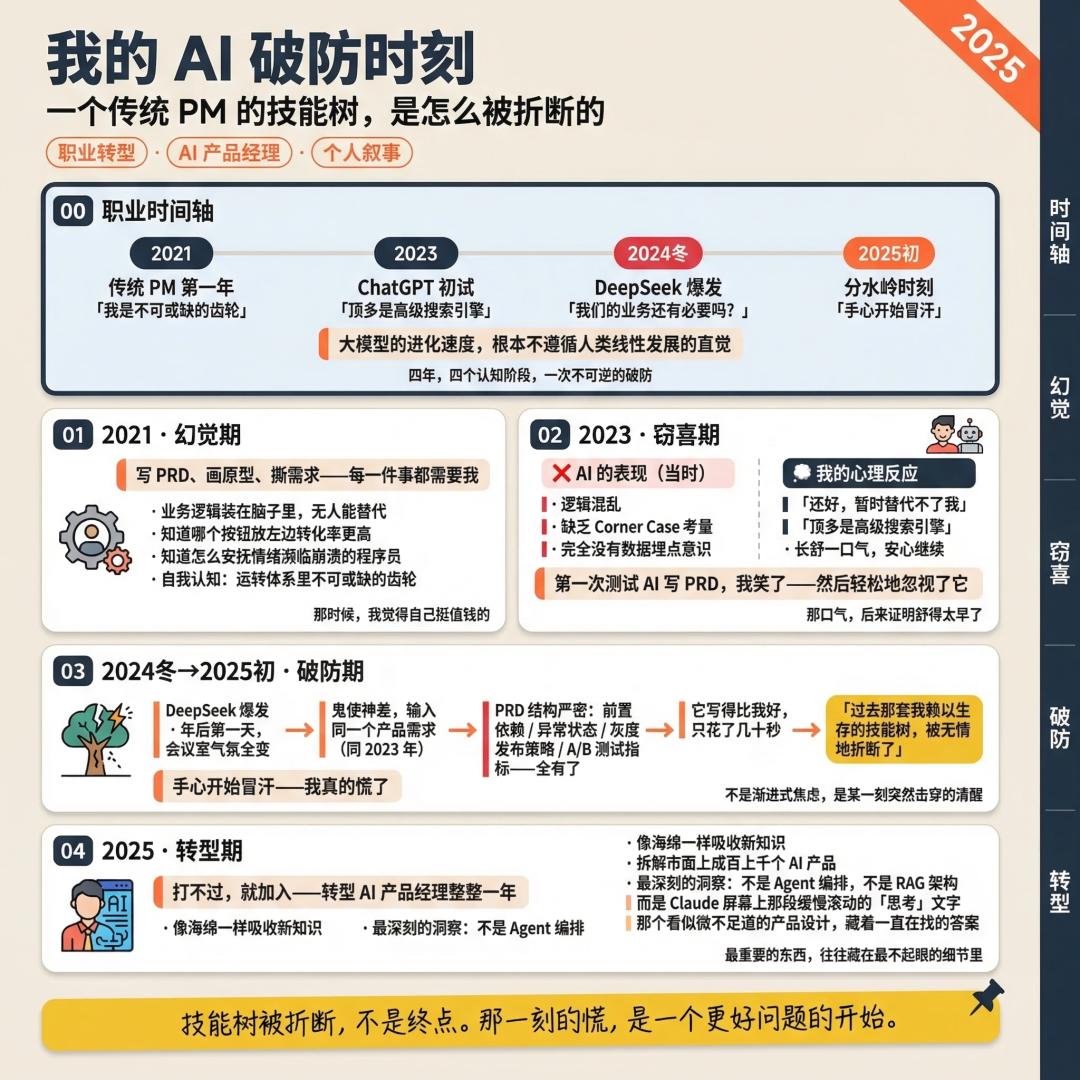
To help you understand this feeling better, let me quickly review my career timeline over the past few years.
2021: The Illusion of Irreplaceability
That was my first year as a traditional product manager (PM). At that time, I felt quite valuable. Writing requirement documents (PRD), creating prototypes, conducting user research, negotiating with developers, and pushing for product iterations—all these tasks required me. My mind was filled with complex business logic; I knew which button placement would yield higher conversion rates and how to calm down stressed-out programmers. I felt like an indispensable cog in the operational system.
2023: A Brief Sense of Relief
When ChatGPT first became popular, I also jumped on the bandwagon. I fed it a real business requirement, attempting to have it help me write a PRD. As I looked at the output, I laughed—it was logically confused, lacked consideration for corner cases, and showed no awareness of data tracking. “Phew,” I thought, “this thing can’t replace me yet; it’s just a more advanced search engine.”
Winter 2024: A Chilling Meeting Room
But the evolution of large models does not follow human linear development intuitions. By the end of the year, DeepSeek exploded. On the first day back to work after the New Year, the atmosphere in the company had changed. Previously, discussions in the meeting room revolved around “how to implement this requirement”; now, everyone sat silently, looking at the projector, discussing “if AI can do this directly, what is the necessity of our business?”
Early 2025: The Turning Point
That afternoon, I inexplicably opened the latest AI model and input a product requirement almost identical to the one from 2023.
I watched the screen, my palms starting to sweat. It not only provided an extremely well-structured PRD but also helped outline dependencies, exceptional states, gray release strategies, and even post-launch A/B testing metrics. What it produced was not only better than mine but also took just a few seconds.
At that moment, I truly panicked. I realized that the skills I relied on for survival had been ruthlessly severed. I then made a decision: if you can’t beat them, join them.
I have been transforming into an AI product manager for a whole year now. During this year, I have absorbed new knowledge like a sponge, dissecting hundreds of AI products on the market. But to this day, what impresses me most is not some flashy agent orchestration or complex RAG architecture.
Instead, it was the moment I used Claude and stared at the slowly scrolling text on the screen—it was “thinking”.
I suddenly realized: this seemingly trivial product design contained the answer I had been searching for.
Claude’s Unconventional Approach
Let’s set aside obscure technical terms and return to a fundamental user experience issue.
Over the past 20 years, internet products have experienced rapid advancement, establishing a set of design principles almost regarded as sacred. What is the core of this principle? It is to hide complexity and present the simplest results to users.
Consider this: when you click “place order” on an e-commerce app, what happens in the backend? The order system generates a transaction, the inventory system deducts stock, the risk control system scans, the payment system initiates, and the logistics system reserves… it’s extremely complex. But as a user, what do you see? You only see a loading animation spinning, followed by a green “payment successful” checkmark.
Skeleton screens, progress bars, loading animations… Over the past 20 years, product managers have invented countless ways to “hide the ugliness”. Our motto is: “Don’t make me think,” which also means: “Don’t let users see how the system thinks.”
But Claude turned this around.
Let’s visually examine the vast gap in interaction experience between two types of AI:
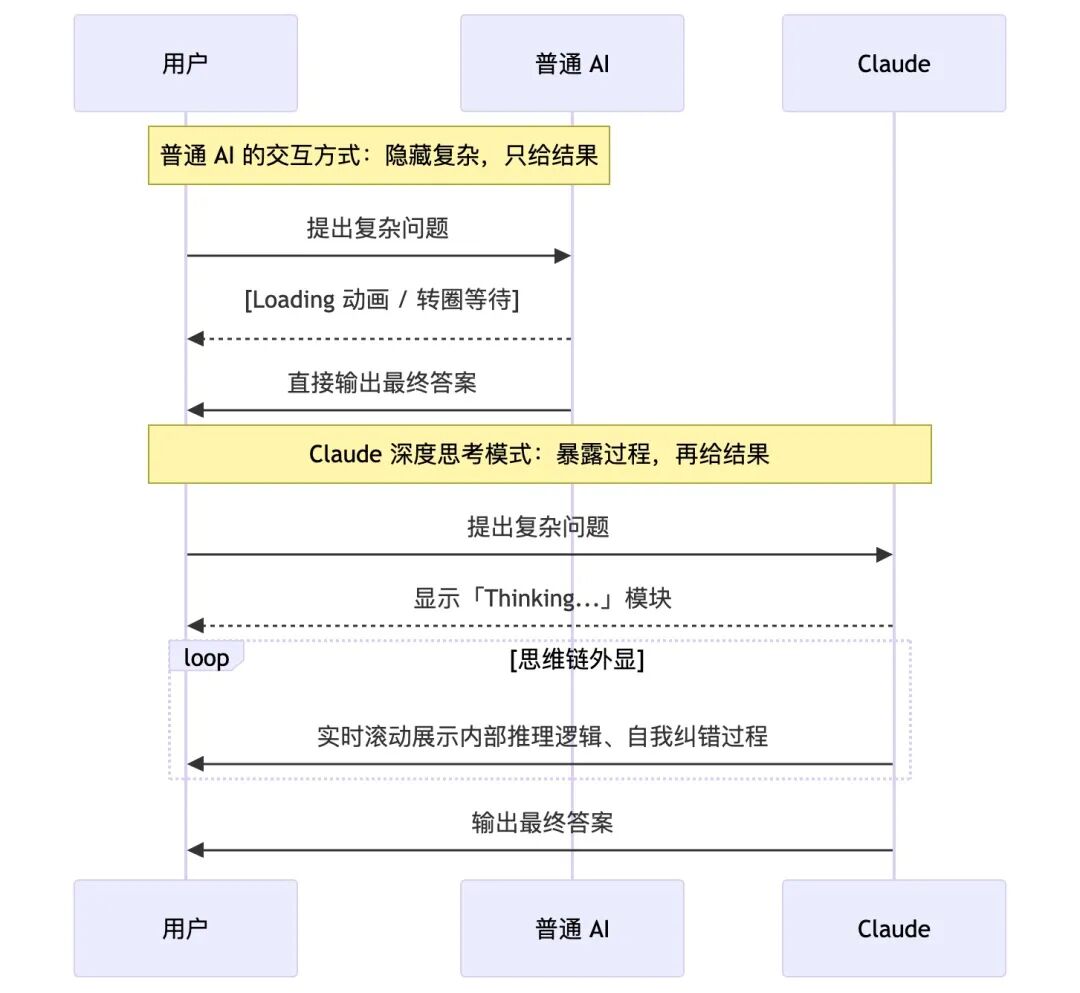
Scenario Restoration: When you pose a complex logical problem to a typical AI, you hit enter. Then, you wait. Maybe the cursor blinks for two seconds, and then, “whoosh,” a perfect answer appears before you. All the user sees is the result.
At this point, someone might ask if DeepSeek R1 also displays the thinking process.
Here’s a comparison:
DeepSeek R1: Displays everything, hides nothing.
You ask it a complex question.
It won’t give you an answer directly.
It will first expose the reasoning process completely through “thinking tokens”—these intermediate reasoning steps show how the model processes the problem before arriving at the final answer.
What you see is:
“From perspective A, there’s a problem… no, that’s wrong. Let’s try perspective B… wait, my previous assumption might be incorrect, let’s start over.”
The uniqueness of DeepSeek R1 lies in the visibility of these intermediate steps to the user, allowing you to watch the model think through the problem in real-time.
What you see is its complete thinking “rough draft”, including mistakes, hesitations, and retractions.
Its reasoning chain typically goes through several stages: redefining the problem, breaking it down into sub-problems, exploring alternative paths, and even self-verifying intermediate results.
Claude: Displays but organizes.
Claude’s thought chain is visible—this is similar to DeepSeek but different from OpenAI.
However, reading it feels entirely different.
Anthropic decided to present Claude’s thinking process in its raw form.
However,
Users may notice that the displayed thought content is more detached and less personalized than Claude’s default output—this is because Anthropic did not train the model’s thinking process with a standard personality, aiming to give Claude the maximum space to think through the necessary content. Just like human thinking, Claude sometimes produces incorrect, misleading, or immature ideas during the process.
In other words: what you see is the real reasoning process, but not a meticulously packaged “perfect reasoning performance”—it resembles a real person’s work draft rather than a final report.
So
When you ask Claude, which has a deep thinking mode, a question, something wonderful happens. Before it provides the final answer, a collapsible module appears on the screen. Inside is the AI’s genuine, rambling “mental activity”: “First, I need to analyze the core demands of the user… wait, if I follow plan A, it might lead to situation B, which contradicts the premise… let me recalculate…”
It not only does not conceal the time taken for calculations but actively presents the most complex, lengthy, and even self-denying internal reasoning process to the user.
This completely violates the common sense of traditional internet product managers. It makes the interface seem bloated, slows down the user’s perception of result acquisition time, and feels like playing the restaurant kitchen’s surveillance footage directly in the dining area.
Why does it do this? Doesn’t Anthropic (the company behind Claude) understand user experience?
No, that’s precisely what makes them so formidable.
Three Layers of Product Logic Behind This Design
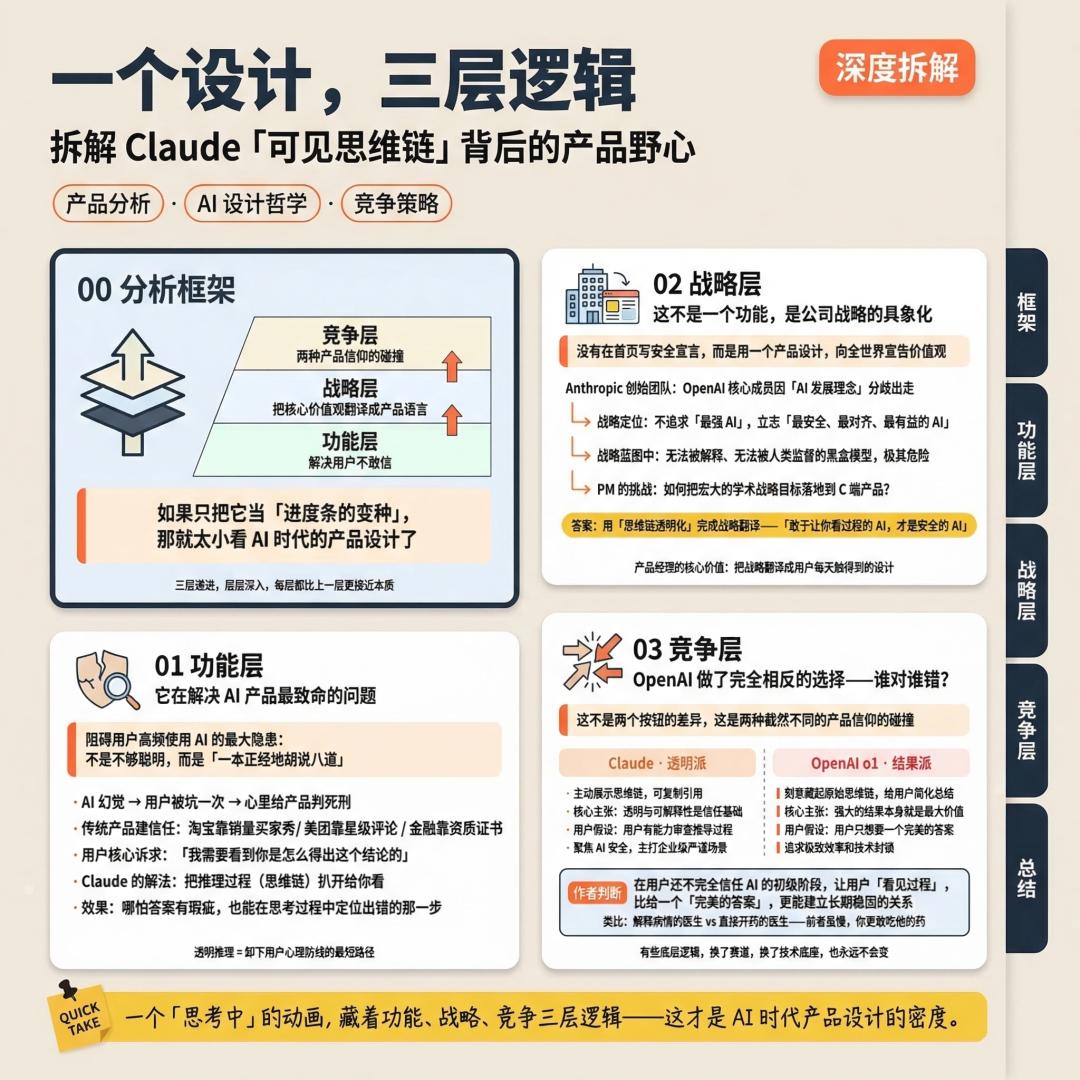
If we only regard it as a “variant of a progress bar”, we underestimate the product design in the AI era. Over this past year as an AI PM, I have gradually learned to deconstruct functions from multidimensional perspectives. The design of Claude’s “Visible Chain of Thought” contains at least three layers of progressively deeper product logic.
First Layer: Functional Level—Solving the Most Critical Issue of AI Products: “Users Don’t Trust”
As an AI PM, I review user data and feedback daily. Do you know what the biggest hidden danger preventing users from frequently using AI is? It’s not that AI isn’t smart enough, but that AI tends to spout nonsense (hallucinations), leading users to distrust it.
Imagine a scenario: you ask AI to help you draft important legal contract clauses. AI generates it in a second. It looks very professional and articulate. But would you dare to use it directly? You wouldn’t. Because you don’t know if it was derived through rigorous legal reasoning or just randomly pieced together from the internet. Once users get burned by AI once, they will mentally sentence the product to death, beginning to doubt every answer it provides.
In traditional products, how do we help users build trust? Taobao relies on sales and buyer reviews; Meituan relies on star ratings and comments; financial products rely on bank custody and qualification certificates. Essentially, in all high-risk decision-making scenarios, the core demand of users is: I need to see “how you arrived at this conclusion”; I need evidence for cross-validation.
Claude’s solution is extremely clever. It doesn’t use flashy UI to assure you of its accuracy; instead, it candidly exposes the reasoning process (thought chain) for you to see.
When you see how it breaks down steps and eliminates incorrect options to answer your question, your psychological defenses come down. Even if its final answer has a slight flaw, you can clearly identify which step’s premise assumption went wrong in the “thinking process” and correct it.
Second Layer: Strategic Level—This Is Not Just a Function, But a Company’s Core Strategy Translated into Product Language
When we step out of the single-function perspective and look at the company’s strategy, you will see the inevitability of this design.
Anthropic is a fascinating company. Its founding team was originally core members of OpenAI, who left due to disagreements with Sam Altman on “AI development philosophy”. From day one, Anthropic has not pursued being “the world’s strongest AI” but aims to create “the world’s safest, most aligned, and most beneficial AI”.
In their strategic blueprint, a black box model that cannot be explained or supervised by humans is extremely dangerous.
So, for an AI product manager, when your boss gives you such a grand, somewhat academic strategic goal, how do you translate it into a consumer product that billions of users interact with daily?
This is precisely where the core value of product managers lies. Anthropic’s PMs did not write lengthy “safety declarations” on the homepage; instead, they chose to use “transparency of the thought chain” as a concrete product design to achieve the translation of strategy.
“I can see what it’s thinking”—this is not just an enhancement of user experience but also serves as an amplifier for Anthropic to announce its values to the world. It forcibly implants a concept in users’ minds: an AI that dares to show you its process is a safe AI.
Third Layer: Competitive Level—OpenAI Made the Opposite Choice, Who Is Right?
At this point, the most exciting part emerges. While Claude widely applies this technology, another great AI company on the planet—OpenAI—made a completely opposite decision in their proud o1 model.
Both companies utilize a reasoning model with “Chain of Thought” technology at the core, but their approaches are polar opposites:
- Claude: Actively displays it, even allowing users to copy and reference the thought process.
- OpenAI o1: Deliberately conceals it. OpenAI explicitly states that to maintain competitive advantage and so-called “user experience”, they generate a simplified “thought summary” for users, while the underlying original thought chain remains an absolute black box.
To clarify the underlying logical conflict between these two, I made a comparison:
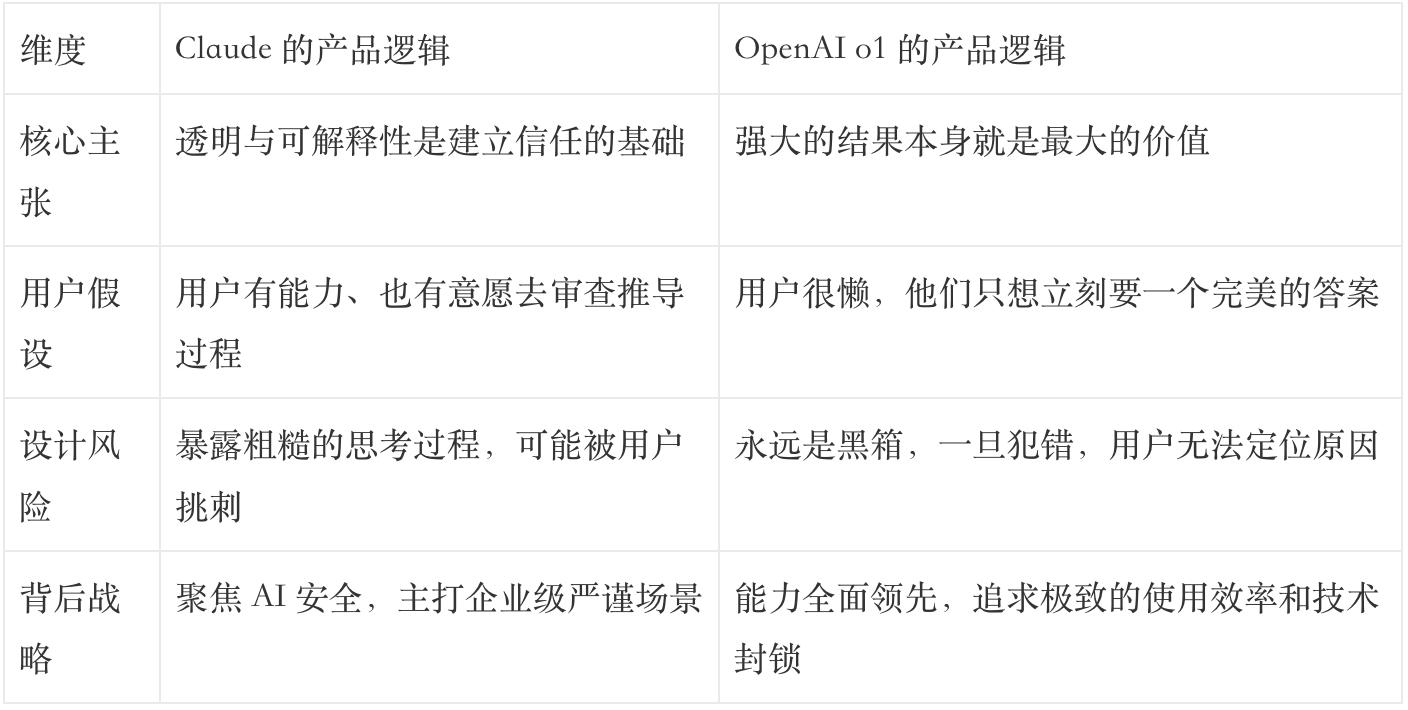
This is not just a difference between two buttons; it’s a clash of two fundamentally different product philosophies. Who is right?
If it were the traditional internet era, I would certainly side with OpenAI. Because Steve Jobs taught us long ago: “Users don’t know what they want until you show it to them.” Providing the final result is always the most efficient.
However, as someone who has transitioned to being an AI product manager for a year, I resonate more with Claude’s judgment in this specific historical slice.
Why? Not because absolute transparency is always better. But because: in this initial stage where users do not fully trust AI and even harbor fear and defense towards it, allowing users to “see the process” builds a more long-term, stable relationship than providing a “perfect answer”.
It’s like going to a hospital. One doctor silently prescribes a bunch of medications, telling you, “Just take them; you’ll be fine”; another doctor pulls out an X-ray, points to the shadows on it, and step-by-step deduces why it’s this illness and why this medication is needed. In today’s fragile doctor-patient trust, while the latter takes more time, you would definitely trust the medication prescribed by the latter more.
This judgment is not mysterious. It aligns perfectly with my understanding of “human nature” accumulated over countless user research sessions during my four years in traditional products. Some underlying logic, even with a change in track and technology, will never change.
A Year Later: What I’m Still Doing
As I write this, the night has deepened.
Having transitioned to being an AI product manager for a whole year, I haven’t become a powerful figure or received a million-dollar offer. I’m still the same person, drawing diagrams, writing documents, and getting frustrated by various ridiculous AI hallucinations every day.
But I am no longer anxious. I persist in doing one thing daily: just like dissecting Claude, I analyze every real AI product on the market and document my thoughts.
Not because I have seen through the industry’s endgame, but because the pace of evolution in this industry is so fast that there are no standard answers. In such a torrent, stopping output means stopping thought; stopping thought means being swallowed by fear again.
I choose to record what I see and touch in this great age of exploration by analyzing real-world AI products in the most straightforward yet solid way.
Just as Claude openly displays its “thinking process” to users, writing this article is also my way of transparently sharing the genuine “cognitive reconstruction process” of a traditional PM over the past year with you.
If you are also a traditional product manager feeling lost, anxious, or still observing amidst the overwhelming wave of AI information, as someone who has been through it, the one thing I want to say to you is:
Panic is a completely normal physiological reaction, but after panicking, you must take action. Use it, dissect it, and find the connections between your past experiences and the new era.
Finally, I want to hear your thoughts: “In embracing this wave of AI, what stage are you currently in? Are you still observing, transitioning, or already navigating this track? What past experiences do you think are still applicable today?”
Comments
Discussion is powered by Giscus (GitHub Discussions). Add
repo,repoID,category, andcategoryIDunder[params.comments.giscus]inhugo.tomlusing the values from the Giscus setup tool.