Chilling Insights from ChatGPT Responses
Recently, artificial intelligence has become a hot topic again. Products like ChatGPT, GPT-4, and Baidu’s Wenxin Yiyan have emerged, showcasing the rapid development of AI technology and the new experiences it brings.
AI can now help summarize, write articles, and even code—going beyond mere snippets to developing websites from hand-drawn sketches. It can solve physics problems, pass various exams, understand memes in images, and create menus based on photos of ingredients in your fridge.
A month ago, I upgraded to a ChatGPT Plus account for $20 and have had several experiences recently. Here, I will share some interesting examples.
Some responses surprised me, making me feel for the first time that AI possesses such strong comprehension, imagination, and expression capabilities. During a late-night conversation, I even felt a sense of “horror”.
Question 1: Guessing Age
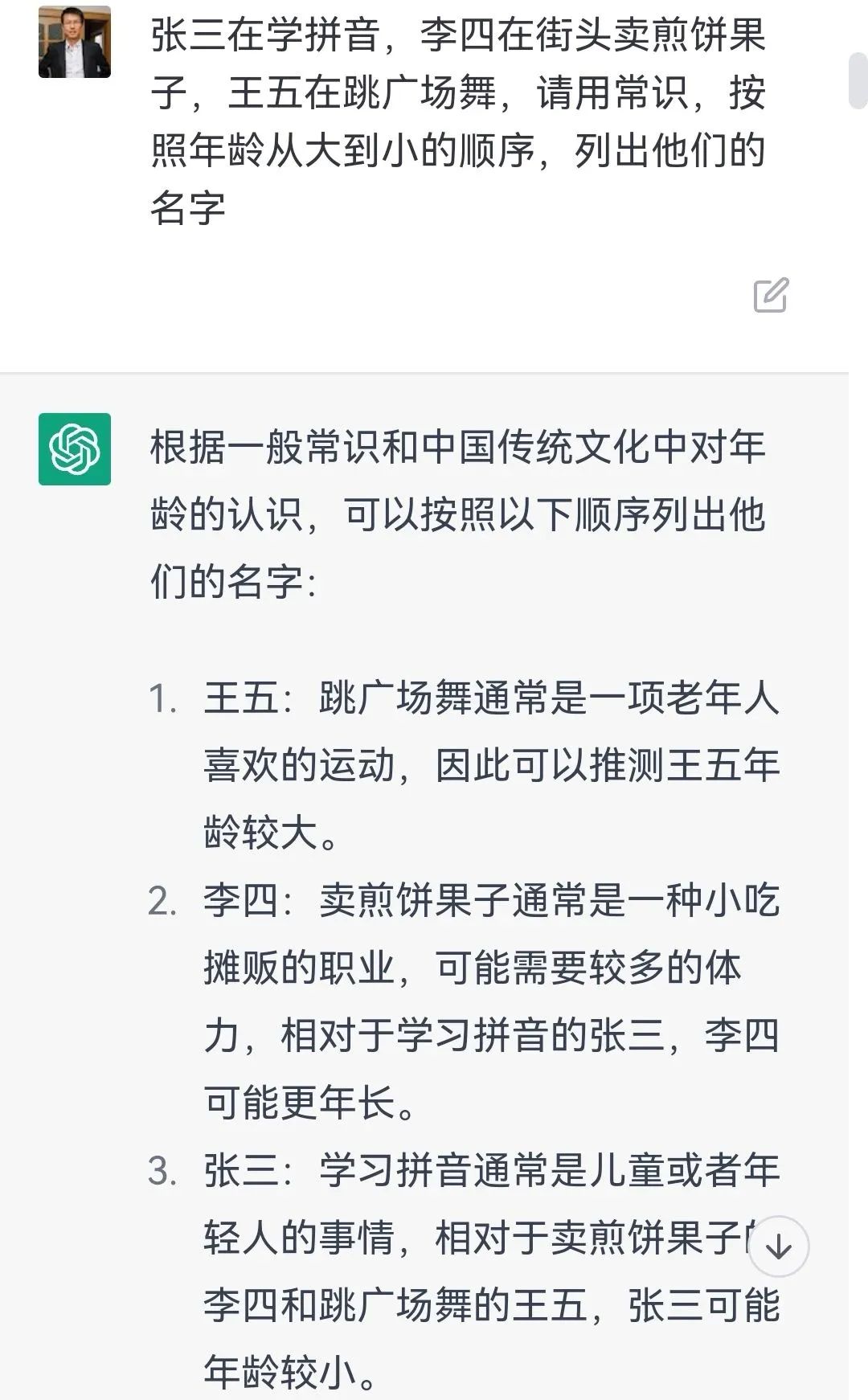
The answer was correct, indicating that ChatGPT has sufficient understanding and social knowledge.
Question 2: Passengers on a Bus
Next, I gradually increased the difficulty to test ChatGPT’s comprehension.

Impressive, right? When I mentioned the year 2050, it immediately referenced “autonomous driving”—truly remarkable! Adding some distractions regarding the passengers didn’t stump it either.
Question 3: Translation and English Teaching
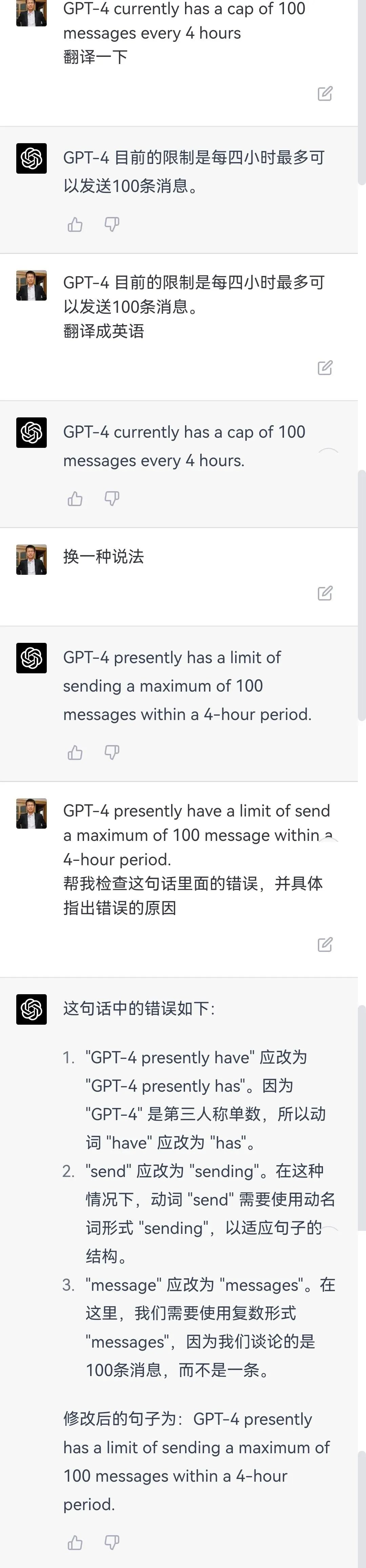
I intentionally wrote incorrect English sentences, and it identified all the mistakes, explaining each one clearly. What a great translator and English teacher!
Question 4: Questions about Literature and History
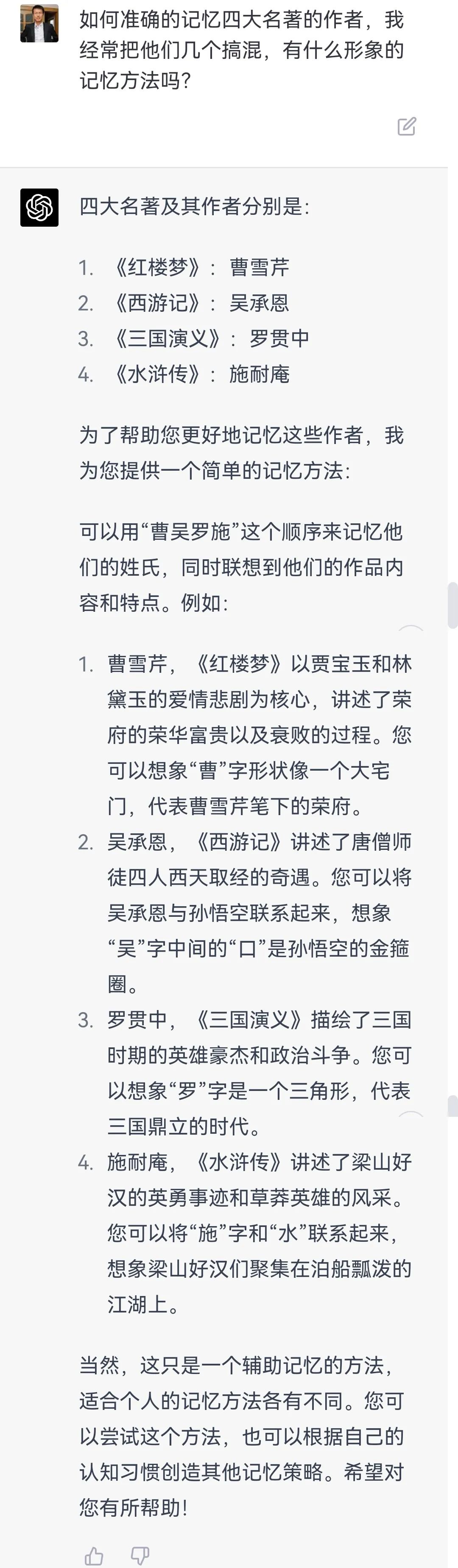
The skills regarding the characters “Cao” and “Wu” were impressive! The character “Cao” resembles a courtyard gate, while “Wu” looks like a tight headband. How could a language model deconstruct characters and associate their shapes with real-life objects? It’s astonishing!
Question 5: Memorizing Atomic Weights
I remembered struggling with memorizing atomic weights in middle school, so I asked if it had any tips.

Although these questions were a bit challenging, its answers were not as intricate as those for the “Four Great Classical Novels”, yet its imagination was incredibly rich! I never expected that!
These examples illustrate that AI is no longer limited to simple information retrieval, organization, and summarization; it possesses understanding, reasoning, and imagination. Sometimes, its responses are unbelievable.
GPT-3 has 175 billion parameters and 45TB of training data, with a model size of 700GB. The subsequent GPT-3.5 and GPT-4 have even larger data sets, parameters, and model sizes.
With so many elements combined, it can “fit” a remarkably strong intelligence.
As training data expands, algorithm parameters are fine-tuned, computing power increases, and countless users provide feedback, the model’s effectiveness will see significant leaps.
In fact, AI models share many similarities with the human brain. Human knowledge and intelligence come from continuous external input and interaction, resulting in the updating and connecting of billions of neurons and synapses. Similarly, AI models, especially those built on deep learning technologies, operate on this principle. However, machines learn faster and have a stronger memory, which is not on the same scale as humans.
Thus, AI’s growth towards human-like capabilities and even surpassing some of them is imminent.
Previously, people generally believed that AI would develop quickly in logical reasoning but would struggle in artistic fields requiring imagination, such as literature, painting, and music. However, the rise of AIGC and AI art last year has demonstrated the power of AI artists.
I have always thought that art is a form of logic or, more dramatically, that “art is also a science”. Art follows rules and logic, and great art and artists have their own consistent internal logic and style.
As AI capabilities continue to improve, it can master various skills and excel in multiple fields.
The above discussion mainly focuses on intellectual work. In reality, with the ongoing development of humanoid robots from companies like Boston Dynamics and Tesla, “intelligent brains and strong limbs” robots will soon walk the streets, integrating into our work and lives.
I recall a discussion with my wife about our only child and whether they would struggle too much when we grow old. I reassured her that in 30 years, when our generation ages, robots will be advanced enough to handle many household tasks, relieving our children from constant burdens.
Looking back, this may have been overly conservative; perhaps this scenario could emerge in just 10 years.
Of course, while there is a law stating that people tend to overestimate the speed and impact of technological development in the short term and underestimate it in the long term, considering AI’s current performance and iteration speed, 10 years is a significant amount of time for astonishing advancements.
Our generation is fortunate to witness the rapid development of technology.
From the early learning machines, 286/386/486/586 PCs, dial-up internet, and WIFI, to DOS, Windows, Android, and iOS, from PC internet to mobile internet, and from 2G, 3G to 4G and 5G, we have transitioned through the third industrial revolution (information technology) to the fourth industrial revolution (artificial intelligence technology).
In the AI era, we will continue to experience and participate, even if we are not directly involved in “algorithms and computing power”—at least we contribute “data”.
“Algorithms, computing power, and data” are all essential.
Moreover, none of us are outsiders; we must also think about our positioning and development for the future, or we will quickly be eliminated.
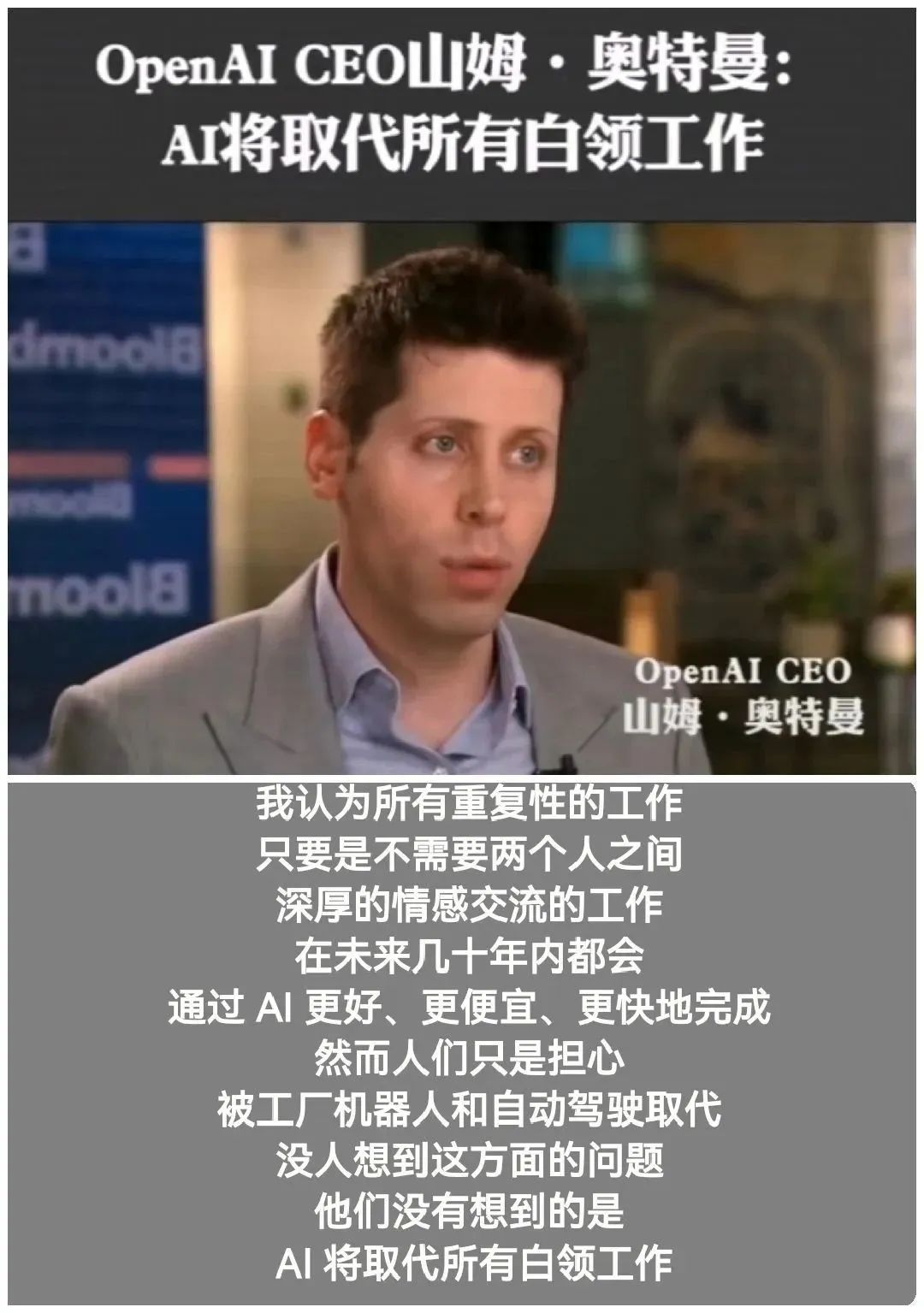
Not only will many repetitive and physical jobs be replaced by machines, but so will many white-collar jobs.
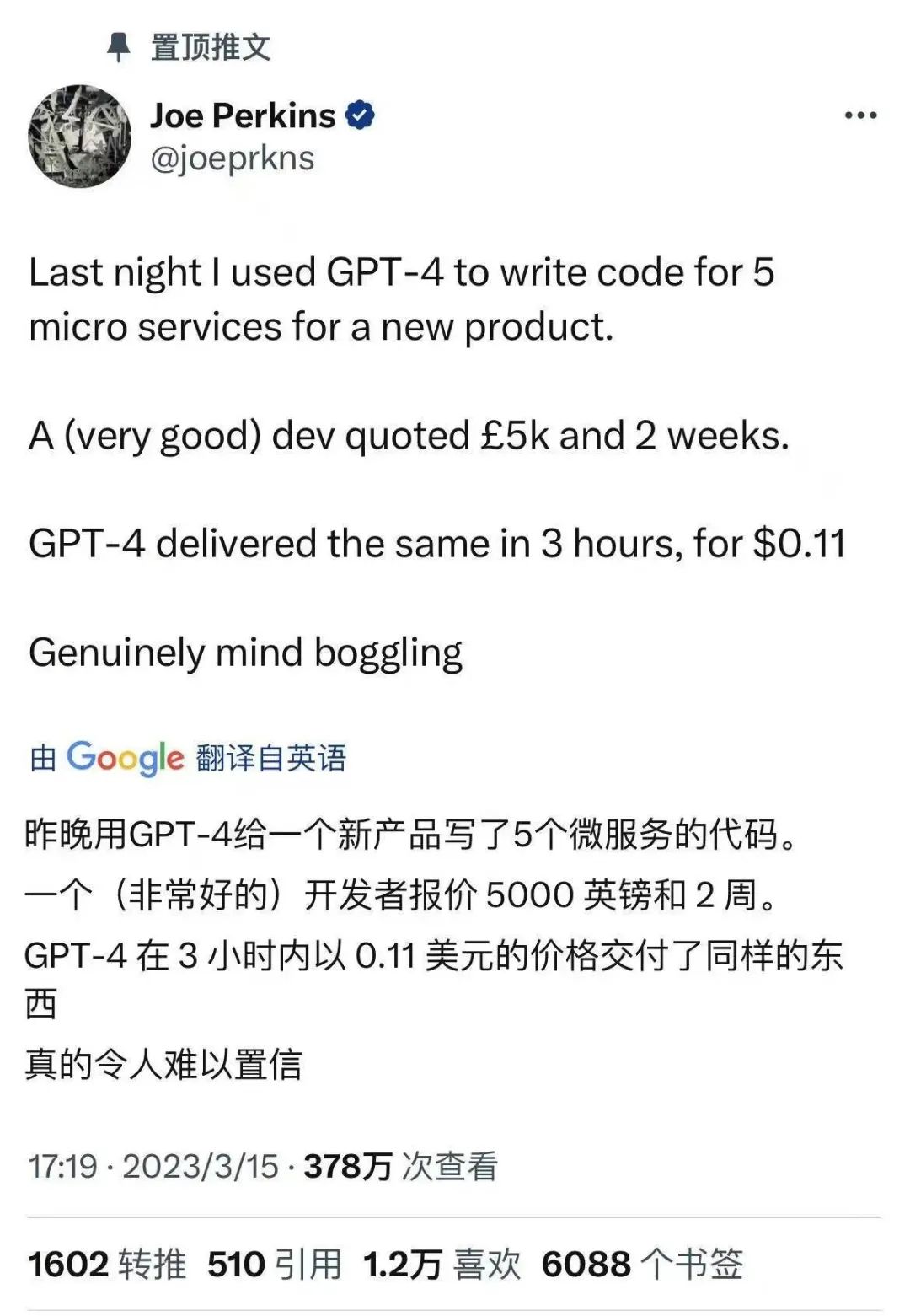
Consider how jobs in painting, translation, and coding are already being affected.
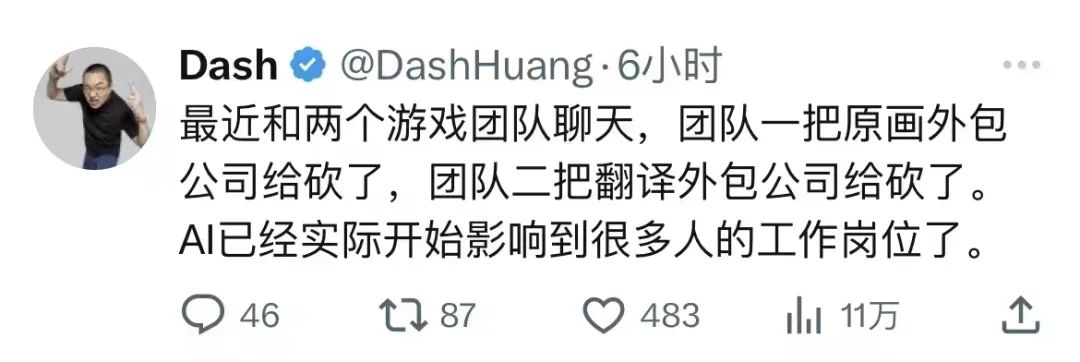
This point has already been clearly stated by OpenAI CEO Sam Altman in an interview.
In addition to focusing on ourselves, we need to deeply consider the education of the next generation. The current education problem is severe; it can be said that we are “using a 20th-century system to impart 19th-century knowledge to cultivate 21st-century talents”. Every parent, teacher, and the entire education sector should reflect and take action.
Next, it’s not just about competing with classmates; we must also compete with AI!
Shifting focus back to the domestic scene, Baidu recently launched Wenxin Yiyan. Although some details of the launch event had issues, overall, it was a positive move. Under such pressure, Baidu’s swift response is commendable.
The problem with that launch event was its complexity and outdatedness. Unnecessary warm-up sessions, opening videos, extravagant PPTs, recorded demonstrations instead of live showcases, and that distracting white belt, among other things.
In reality, with ChatGPT already popular and GPT-4 having made its debut, Baidu only needed a simple, direct product launch and demonstration.
There was no need for fancy event designs or high-level executives like Robin or Haifeng to take the stage. Such products differ from those focused on backend or B2B; just a few compelling live demonstration cases would suffice to ignite the internet and showcase strength.
Objectively speaking, Baidu has the most accumulated experience and strength in products and technologies similar to ChatGPT.
I believe and look forward to Baidu iterating excellent products and creating new glories!
Finally, let’s discuss the industry’s tendency to chase trends and create hotspots.
I remember a few months ago when ChatGPT was released, the tech, investment, and media circles in China were thrilled. Many organizations and individuals claimed they had been “laying the groundwork and accumulating for years” in this field.
Suddenly, previously less popular topics like “blockchain, VR, and the metaverse” were neglected. Not only did they lose the spotlight, but many projects and teams were even directly cut.
The internet and tech circles are like this: many concepts, technologies, terms, and hotspots.
Hotspots, windows, and trends are not wrong for market opportunities.
Especially for application-based technologies and products like e-commerce, group buying, video, and live streaming, the time window may be short, requiring quick action and launch. However, for deep technologies like AI, achieving results cannot be accomplished merely by chasing trends and fads within a few months or a couple of years.
ChatGPT and OpenAI have invested five to eight years of focused effort to achieve their remarkable performance!
Similarly, look at Tesla and SpaceX; which of them did not achieve success after years of dedicated technical breakthroughs, product iterations, and countless challenges?
Therefore, we need to cultivate patience and focus, reducing restlessness. In any field, long-term dedication will naturally yield results.
If we jump from one hot topic to another without mastering core technologies, how can we expect to succeed?
If everyone is patient, focused, and reliable, society will be strong and harmonious.
I look forward to that intelligent era and hope that Chinese people can lead trends in the tech field.
Comments
Discussion is powered by Giscus (GitHub Discussions). Add
repo,repoID,category, andcategoryIDunder[params.comments.giscus]inhugo.tomlusing the values from the Giscus setup tool.